


What if the first thing your body learned each morning wasn’t to prepare for pain, but to prepare for possibility?
For many people living with chronic pain, mornings can become surprisingly predictable. Your eyes open, you take a breath, and before your feet even touch the floor, your mind is already checking in:
How bad will it be today?
That moment of anticipation matters.
When pain has been part of your life for a long time, your body can learn to expect it. Shoulders tighten. Muscles brace. Breathing becomes shallow. Your mind scans for discomfort before you’ve even started your day.
This doesn’t mean your pain isn’t real. It means your nervous system may have learned a protective pattern around it.
And learned patterns can be changed.
What Is a Morning Pain Inventory?
A Morning Pain Inventory is a simple practice of paying attention to what happens in your body and mind when you first wake up.
Instead of immediately judging your pain as “good” or “bad,” you become curious.
Ask yourself:
- What sensations do I notice?
- Where do I feel tension?
- What thoughts appear first?
- Am I holding my breath?
- What happens when I slowly move?
- What did my body experience yesterday?
This kind of awareness can help you recognize patterns that may otherwise go unnoticed.
For someone practicing morning pain management, awareness is often an important first step.
Why Do I Wake Up Expecting to Feel Pain?
If you’ve experienced pain repeatedly upon waking, your brain can begin creating an expectation around that experience.
Your body remembers.
You may start waking up with pain before you’ve consciously checked how you actually feel. The anticipation itself can create tension, which may make existing discomfort feel more intense.
This is sometimes described as the pain anticipation cycle:
Expectation → tension → heightened awareness → discomfort → more expectation.
Breaking this cycle isn’t about pretending your pain doesn’t exist. It’s about giving your nervous system a different experience when you wake up.
How Anticipating Pain Affects the Body
Your nervous system is constantly deciding whether your environment feels safe or threatening.
When you anticipate pain, your body may respond protectively. Muscles can tighten, breathing can change, and your attention may become hyper-focused on physical sensations.
This connection between the nervous system and pain is one reason mind-body pain management can be so valuable.
The goal isn’t to “think your pain away.”
It’s to create conditions in which your body doesn’t have to remain on high alert.
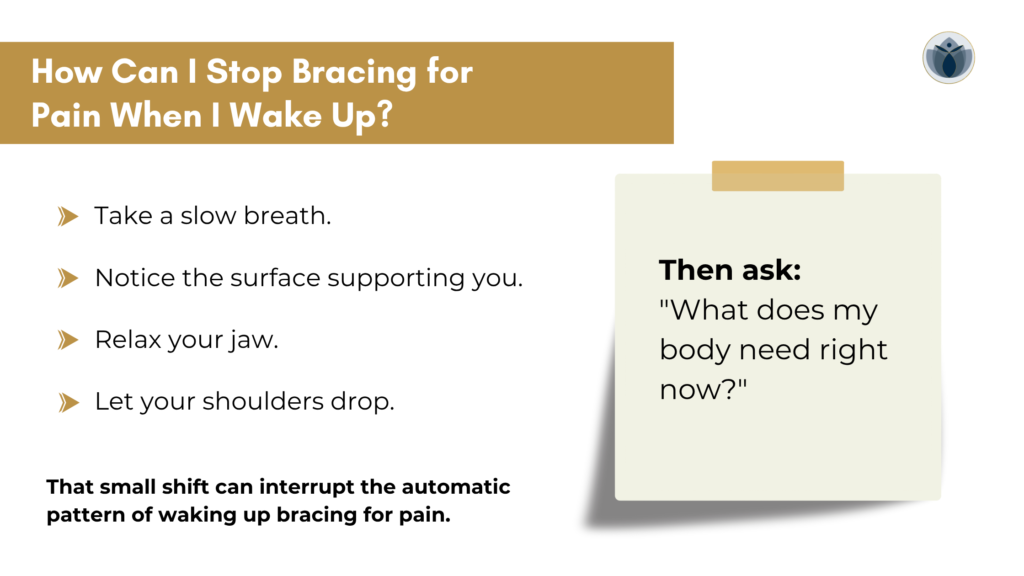
How Can I Stop Bracing for Pain When I Wake Up?
Start by changing what happens during those first few minutes.
Instead of immediately sitting up and scanning for everything that hurts, pause.
Take a slow breath.
Notice the surface supporting you.
Relax your jaw.
Let your shoulders drop.
Move one part of your body gently before attempting to get out of bed.
Then ask:
“What does my body need right now?”
Not, “How much pain am I going to have today?”
That small shift can interrupt the automatic pattern of waking up bracing for pain.
Techniques to Reduce Morning Tension and Discomfort
If you’re trying to reduce morning pain, experiment with gentle practices rather than forcing your body into movement.
Try gentle breathing
Take several slow breaths and allow your exhale to become slightly longer than your inhale.
Move slowly
Before getting out of bed, gently move your fingers, ankles, shoulders, or other comfortable areas.
Notice without judging
Instead of labeling a sensation as “bad,” describe it neutrally: tight, warm, heavy, pulling, stiff, or tender.
Give yourself time
You don’t have to rush from sleep directly into the demands of the day.
These simple pain management strategies are ways real estate agents can manage stress, back pain, and burnout naturally.
Your Morning Doesn’t Have to Start With Pain
The first few minutes of your day can become more than a daily pain check.
They can become a moment of connection.
A moment to breathe.
A moment to listen.
A moment to remind your body that you don’t have to brace for everything that comes next.
If you’re living with persistent pain, you deserve an approach that looks beyond the surface of your symptoms and considers the relationship between your body, emotions, experiences, and nervous system.
Ready to Explore a Different Approach to Pain?
Jacqueline M. Kane, is a Master Energy Healer and Low Back Pain Specialist, who helps people explore the deeper patterns that may be connected to persistent pain and discomfort.
Through a holistic approach that considers the mind, body, and energy, Jacqueline Happy Low Back helps you move beyond simply coping with pain and begin exploring what your body may be asking for.
FAQs
Why do I wake up expecting to feel pain?
When pain has occurred repeatedly, your brain and nervous system can learn to anticipate it. That expectation may contribute to muscle tension and heightened awareness of physical sensations.
How can I stop bracing for pain when I wake up?
Pause before moving, breathe slowly, notice your body without judgment, relax areas of unnecessary tension, and introduce gentle movement before getting out of bed.
Can tracking morning pain help identify patterns and triggers?
Yes. A simple morning journal can help you identify relationships between pain, sleep, stress, activity, emotions, and other potential triggers.
How does anticipating pain affect the body?
Anticipating pain can increase vigilance and protective muscle tension. This may make existing discomfort feel more noticeable or intense.
What techniques can help reduce morning tension and discomfort?
Gentle breathing, mindful awareness, slow movement, stretching when appropriate, hydration, and a calm morning routine can support relaxation and mobility.
How can mindfulness help with morning pain?
Mindfulness allows you to observe sensations without immediately attaching fear or predictions to them. This can help reduce the emotional reaction surrounding pain.
Can nervous system regulation help with waking up in pain?
Nervous system regulation practices such as slow breathing, grounding, mindfulness, and gentle movement may support a calmer response to physical sensations.
How can I create a calming morning routine when I live with chronic pain?
Start slowly. Give yourself several quiet minutes to breathe, notice your body, move gently, hydrate, and transition into your day rather than immediately rushing into tasks.
Why does pain sometimes feel worse immediately after waking?
Stiffness from remaining in one position, sleep quality, inflammation, stress, and nervous-system sensitivity can all influence how pain feels in the morning.
How can I retrain my body to stop automatically bracing for pain?
Practice noticing when you brace, soften unnecessary tension, breathe slowly, move gently, and respond to sensations without automatically predicting the worst. Consistency matters more than perfection.