
Provide. Protect. Perform. Don’t complain. Don’t show weakness. Keep going even when you’re running on empty.
Nobody sat you down and taught you these rules. You just absorbed them. From your dad. From your coaches. From a culture that quietly admires the man who never stops and never asks for help.
But here’s what nobody tells you: your body doesn’t care about the rules.
Men’s Mental Health Awareness month comes around every June, and suddenly everyone wants to talk. But talk is cheap. What you actually need to understand is what’s happening beneath the surface, in your nervous system, in your tissues, in the quiet places where all that unprocessed pressure has been living for years.
The Real Cost of “Being Strong”
Let’s get honest about what constant pressure feels like in your body.
That tightness in your chest when you think about work. The short fuse that embarrasses you later. The Sunday night dread that starts showing up on Saturday afternoon. The way your jaw is clenched right now as you read this, and you didn’t even notice until I mentioned it.
This isn’t weakness. This is chronic stress, your nervous system stuck in “go” mode with no off switch.
But mental fatigue doesn’t just disappear because you ignore it. It settles into your shoulders. Your lower back. Your gut. It shows up as irritability you can’t explain, as trouble sleeping, as that feeling of being disconnected from your own life.
Why Men Struggle to Notice They’re Drowning
Here’s the thing about men’s mental health awareness, it assumes you know something’s wrong. But when you’ve been under pressure for years, that pressure becomes normal. You forget what calm feels like.
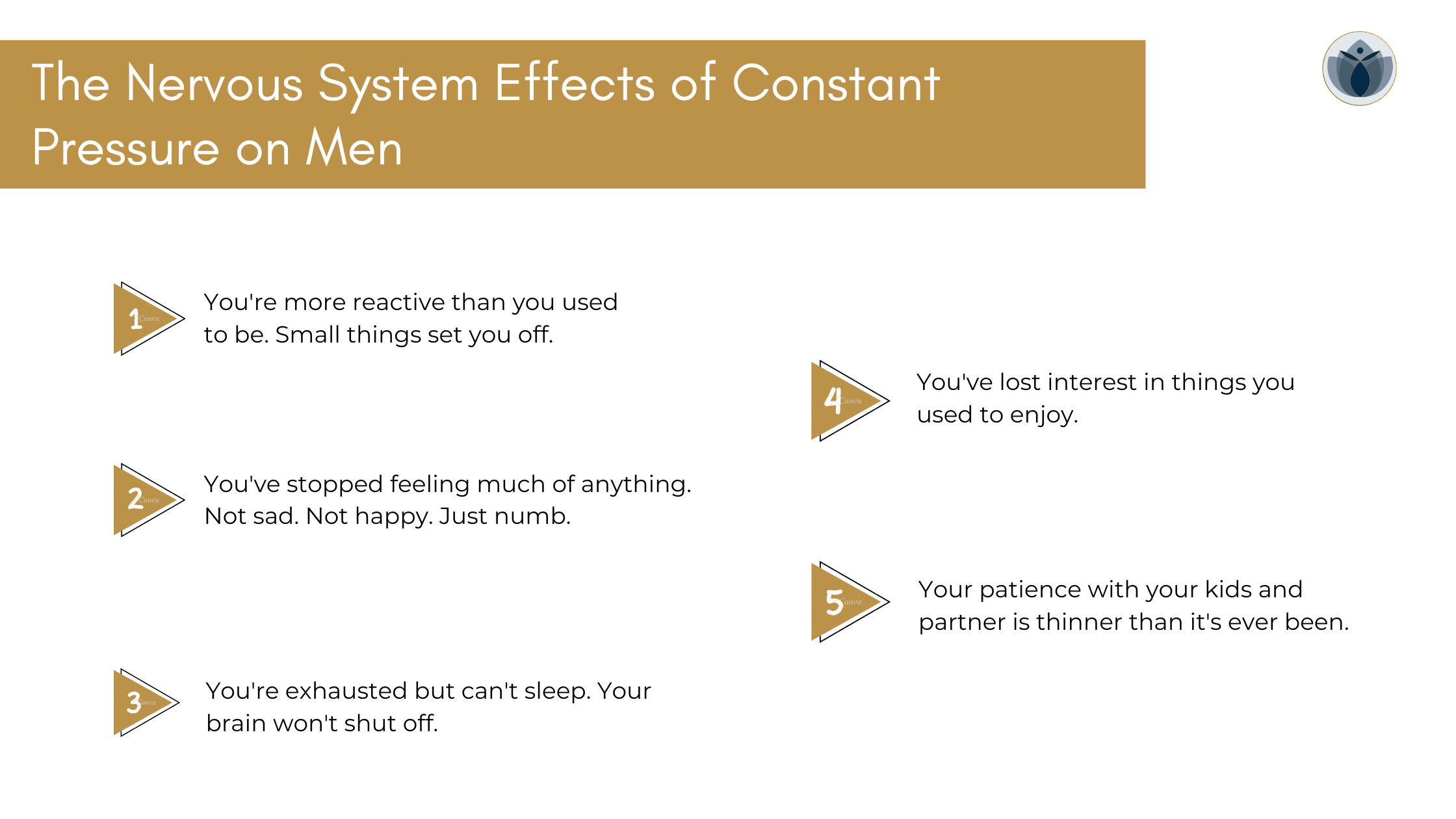
You might notice:
- You’re more reactive than you used to be. Small things set you off.
- You’ve stopped feeling much of anything. Not sad. Not happy. Just numb.
- You’re exhausted but can’t sleep. Your brain won’t shut off.
- You’ve lost interest in things you used to enjoy.
- Your patience with your kids and partner is thinner than it’s ever been.
If any of this sounds familiar, you’re not broken. You’re running on a nervous system that hasn’t had a real break in years.
Men’s wellness isn’t about green smoothies and meditation apps. It’s about understanding that your body has limits, and you’ve been ignoring them for too long.
What Constant Pressure Actually Does to Your Nervous System
Your nervous system has two main modes: “go” and “rest.”
“Go” mode keeps you alert, focused, ready for threats. It’s great for closing deals, handling crises, and pushing through challenges. But it was designed for short bursts, not for years of nonstop pressure.
When you live in “go” mode 24/7, your system starts breaking down. Sleep suffers. Digestion suffers. Mood suffers. Your ability to think clearly, to connect with people, to feel joy, all of it gets harder.
This is the hidden cost of constant pressure. It’s not just that you’re tired. It’s that your nervous system has forgotten how to rest. And this could be a sign that you are running on empty and what to do about it.
How Constant Pressure Shows Up in Real Life
Ask yourself:
- When’s the last time you felt truly relaxed?
- When’s the last time you weren’t thinking about work, money, or responsibilities?
- When’s the last time you cried?
If those questions make you uncomfortable, that’s exactly the point. You’ve been taught that discomfort is danger. That feeling anything other than “fine” is failure.
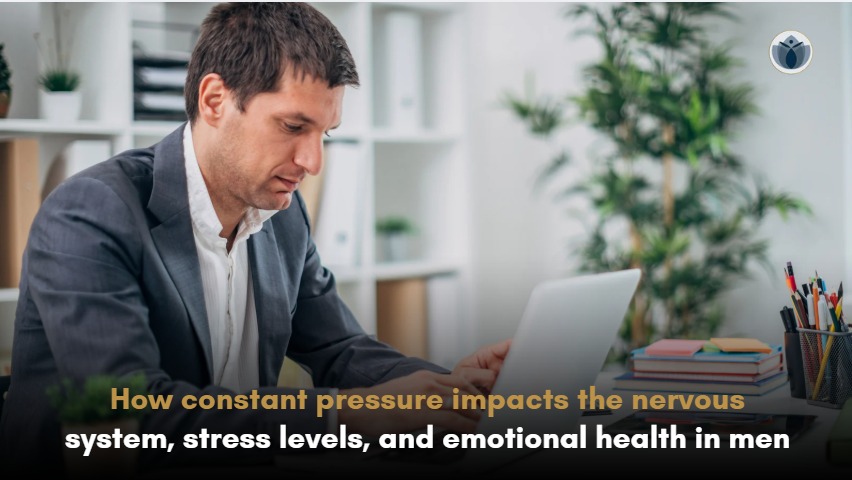
But how constant pressure affects the nervous system in men isn’t mysterious. It’s physics. Pressure builds. And if it has nowhere to go, it starts breaking things.
The First Step: Admitting You’re Human
You don’t need another productivity hack. You don’t need to “man up.” You need permission to be human.
Why men struggle with emotional exhaustion comes down to one thing: you’ve been told your whole life that exhaustion is for everyone except you. That you have to carry the weight alone.
But here’s the truth nobody told you: asking for help isn’t weakness. It’s the strongest thing you can do. Recognizing that you’re struggling isn’t failure. It’s the first step toward actually fixing something.
How to Start Regulating Your Nervous System
How to regulate the nervous system after burnout starts with tiny, consistent actions. Not a complete life overhaul. Just small moments of noticing and choosing differently.
1. Name it: When you feel tension, say it out loud. “My shoulders are tight.” “I’m feeling overwhelmed.” Naming what’s happening moves you from being controlled by the stress to observing it.
2. Breathe like you mean it: When you’re triggered, your breath gets shallow. Consciously slow it down. Inhale for 4 counts. Exhale for 6. The longer exhale tells your nervous system, “We’re safe now.”
3. Move the energy: Tension isn’t imaginary. It’s physical. Shake out your hands. Roll your shoulders. Go for a short walk. Your body needs to discharge the pressure, not just think about it.
4. Stop going it alone: This is the hardest one for men. But nervous system healing doesn’t happen in isolation. Find someone you trust. A friend. A coach. A therapist. Someone who won’t tell you to “toughen up” but will actually listen.
The Quiet Truth
Men’s Mental Health Awareness month matters because most men are suffering in silence. You’ve been taught that your value is in what you provide, not who you are. That your struggles are yours alone to handle.
But that’s a lie.
The strongest men I know aren’t the ones who never break. They’re the ones who admit when they’re broken and ask for help putting the pieces back together.
You’ve been carrying this weight alone for long enough. It’s time to put it down.
If you’re ready to stop carrying the weight alone, Jacqueline works with men who are tired of living in survival mode. Through her personalized coaching, you’ll learn practical tools for nervous system healing, release the chronic stress that’s been living in your body, and finally understand how to regulate the nervous system after burnout without quitting your life.
FAQs
How constant pressure affects the nervous system in men?
Constant pressure keeps your nervous system stuck in “go” mode alert, reactive, unable to truly rest.
Why men struggle with emotional exhaustion?
Men are often taught to suppress emotions, push through discomfort, and handle problems alone.
How to regulate the nervous system after burnout?
Start small. Name what you’re feeling instead of pushing through. Breathe with a longer exhale to signal safety.